
Mozart's Requiem: a mass left unfinished
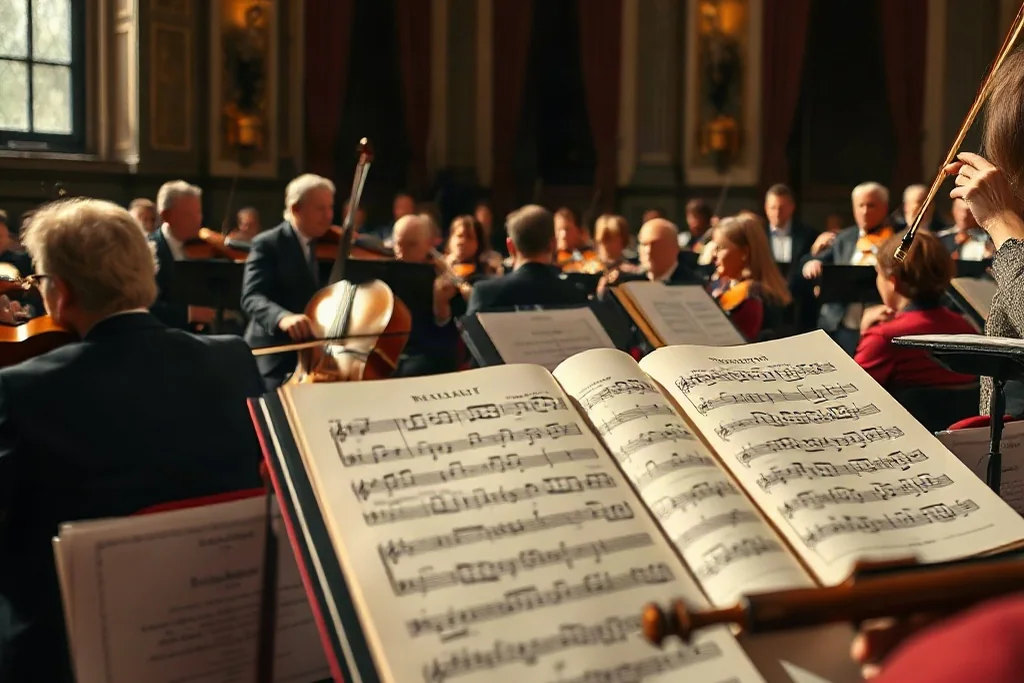
Mozart's Requiem is a funeral mass that he did not live to finish. The work was commissioned anonymously, left incomplete at his death, and completed by others working from his sketches and directions. That history is not a footnote: it shapes how the piece is heard, because some movements come down to us in the composer's own hand and others are reconstructed. A listener who knows this hears differently.
The music itself is dark, solemn and remarkably direct. It belongs to the tradition of sacred music for the dead, and it uses the standard sections of a requiem text. Within those constraints Mozart writes with the same clarity found in his other works, at a lower temperature.
What a requiem mass contains
A requiem sets a fixed sequence of texts. Some sections are contemplative, others are dramatic, and one is a long poetic sequence that a composer may divide into several contrasting movements. The result is a large work with a built-in emotional arc that the composer shapes rather than invents.
Knowing the order helps a listener stay oriented. After the opening plea for rest comes anger and judgement, then grief, then a final appeal for light.
How the completion works
At Mozart's death, the opening sections existed substantially in his hand. The remainder was completed by a pupil following his instructions and, in later versions, revised by others. Modern performances usually follow one of a small number of established completions, and the difference between them is audible in the orchestration.
This is a case where the honest answer to the question of authorship is layered. The plan is Mozart's; the finishing is not entirely.
Listening points
- The opening is slow and severe, with a heavy orchestral tread.
- A later movement erupts suddenly and then subsides.
- One solo quartet movement is lyrical rather than dramatic.
- The closing pages turn toward light, however austere the route.
Listen for the trombone and basset horn colours, which give the score part of its particular darkness.
The Requiem in outline
| Section | Tone | Feature |
|---|---|---|
| Opening plea | Solemn | Slow, weighty tread |
| Judgement | Dramatic | Sudden loud outbursts |
| Offering | Lyrical | Solo voices in quartet |
| Sanctus and Benedictus | Ceremonial | Bright shift in colour |
| Final appeal | Restrained hope | Return of the opening mood |
Why the unfinished state matters
An unfinished work invites speculation, and speculation has produced more legend than fact. It is enough to know that a substantial part of the music is firmly documented and the rest follows the composer's plan. Treating the whole as an authentic statement by one hand, or dismissing the completed sections as mere imitation, both overshoot the evidence.
The practical consequence for a listener is simple: the piece is performed as a whole and can be heard as a whole, as long as the seams are understood.
How to hear a sacred text you do not know
Sacred choral music sets words, and the words carry the shape. A listener who does not know the Latin can still follow the emotional sequence: supplication, alarm, consolation, ceremony, and a final appeal. Composers write to those turns, and the music makes them audible even without translation.
The most reliable method is to read a short summary of the text before listening and then let the music move through it. A second listen, with the text alongside, will confirm where each shift falls and why a movement ends the way it does.
Where to go next
Listen once without reading anything, then listen again following the text in translation. The shift in attention between the two hearings is the clearest demonstration of why sacred music is written the way it is.
Read next
Beethoven's Fifth Symphony: four notes that changed everything
How a tiny rhythmic cell becomes the organising idea of an entire symphony.
Vivaldi's Four Seasons: music as description
What a concerto can do when it sets out to paint weather, birds and seasons.
Tchaikovsky's Nutcracker: from stage work to concert suite
Why a ballet score became one of the most familiar orchestral suites.