
Home › Instruments & Orchestra
Woodwind and brass: how the wind sections differ
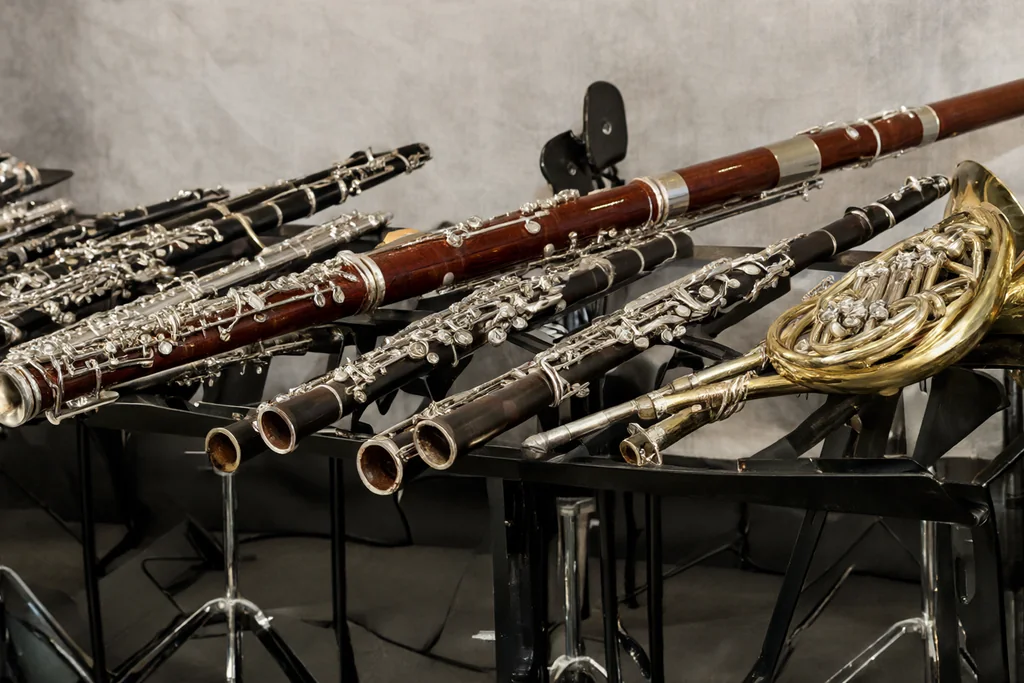
Woodwind and brass are often grouped together in casual conversation and separated carefully in orchestral practice. Both are wind instruments played by a single player per part, but they produce sound in quite different ways and have different strengths. Knowing the difference makes the wind writing in orchestral music much easier to follow.
The distinction is mechanical. Woodwind instruments set a column of air vibrating at an edge or through a reed, while brass instruments rely on the player's lips vibrating against a mouthpiece. That difference shapes both the sound and the playing technique.
How woodwind produces sound
Flutes direct a stream of air across an opening. Single-reed instruments vibrate a thin cane reed against a mouthpiece. Double-reed instruments use two reeds vibrating against each other. All three methods give the player fine control over nuance, and all three allow very rapid articulation.
The consequence is agility. Woodwind instruments can play fast, detached passages that would be impractical elsewhere, and their tone colours are distinct enough to be recognised individually.
How brass produces sound
Brass players buzz their lips into a cup-shaped mouthpiece, and the length of tubing determines the pitch. Valves or a slide change that length during playing. The technique requires breath control and physical stamina, and the sound is both powerful and directional.
Brass is therefore used for weight and ceremony rather than for rapid figuration, though the agility of the instruments is greater than the stereotype suggests.
The main instruments
- Flute and piccolo: bright, high, capable of great speed.
- Oboe and cor anglais: reedy and penetrating, often used for plaintive solos.
- Clarinet and bass clarinet: warm and wide-ranging, with a smooth low register.
- Bassoon and contrabassoon: dark and humorous, the bass of the woodwind group.
- Horns, trumpets, trombones and tuba: the brass group, from blended to blazing.
Each instrument has a register in which it is strongest, and composers write to those registers rather than fighting them.
Wind families compared
| Family | Sound production | Strength in writing |
|---|---|---|
| Woodwind | Edge or reed | Speed, individual colour, gentle nuance |
| Brass | Vibrating lips | Power, weight, ceremonial climax |
| Woodwind blend | Mixed colours | Chordal writing with distinct parts |
| Brass blend | Matching timbre | Solid, unified mass of sound |
| Combined | Both | Bright climaxes with inner detail |
Blending within and between
Woodwind instruments blend with each other in pairs but remain distinguishable, so a woodwind chord often sounds like several colours held together. Brass instruments blend more completely, so a brass chord tends toward a single massive sound. That is why one group suits detailed counterpoint and the other suits broad, unified statements.
Horns are the bridge. Their tone can lean towards woodwind warmth or towards brass power, which makes them the most versatile instruments in the wind ensemble.
Recognising the wind colours by ear
The most reliable way to learn the wind instruments is to hear the same kind of melody played by each one. A slow line for flute, oboe, clarinet and bassoon in turn makes the differences obvious in a way that orchestral listening rarely does, because the orchestral context keeps changing the surrounding sound.
Start with the double reeds, which are the easiest to identify: their tone is focused and slightly nasal, and it carries through an ensemble without effort. Once the oboe is secure, the clarinet and flute fall into place quickly, and the brass group is usually unmistakable from the first note.
Where to go next
Find a passage where a wind instrument takes over a melody from the strings and listen to how the character changes. That handover is one of the clearest ways to hear what a wind colour actually contributes.
Read next
The sections of the orchestra and how they work together
Strings, woodwind, brass and percussion: roles, ranges and how they blend.
The string family: violin, viola, cello and double bass
Four sizes of one idea, and why the string body carries so much of the repertoire.
The piano: a percussion instrument in disguise
How strings, hammers and pedals make the piano both intimate and orchestral.