
Home › Instruments & Orchestra
The string family: violin, viola, cello and double bass
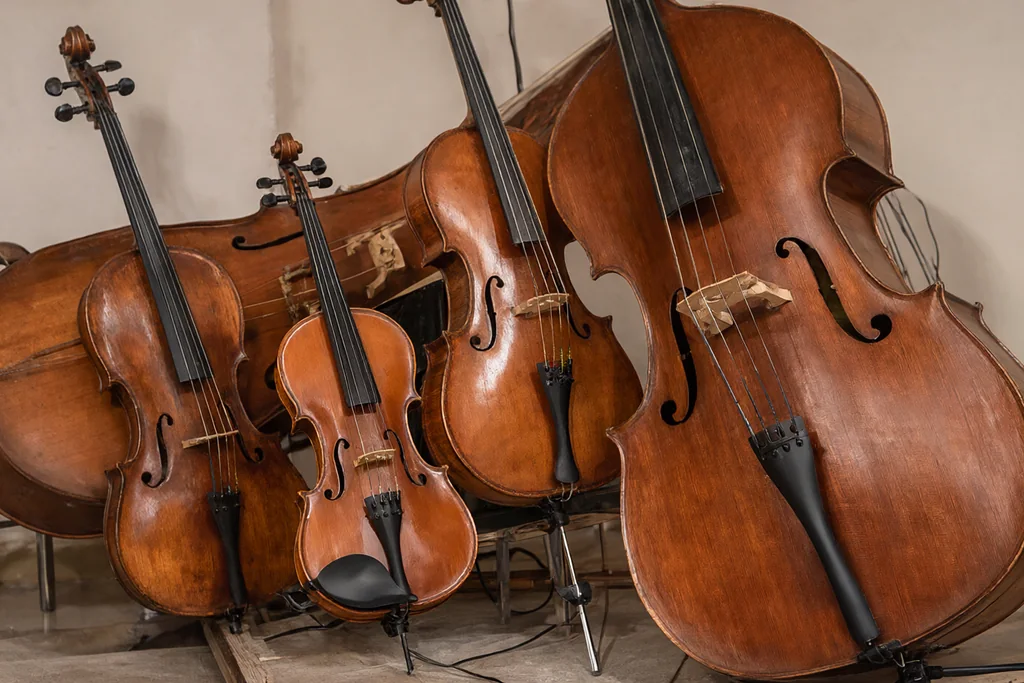
The string family is one idea built at four sizes. The violin, viola, cello and double bass share a shape and a technique: strings stretched over a wooden body, set vibrating with a bow of horsehair. Because they share so much, they blend with each other more completely than any other group in the orchestra, and because they differ in size, they cover an enormous range.
This page describes the four instruments, what distinguishes them in sound, and why the family carries so much of the repertoire.
Why one design at several sizes
A longer string sounds lower, and a larger body resonates more deeply. Scaling the same design therefore produces a family of instruments with matching tone but different registers. The result is that a composer can write four parts that sound like one instrument playing chords, or four parts that sound like a conversation between distinct voices.
The family's uniformity is also why string sections are large. Many players on the same part produce a single rich sound rather than many separate ones.
The four instruments
The violin is the smallest and highest, the natural carrier of melody. The viola is larger and lower, with a darker and more veiled tone that makes it ideal for inner parts and melancholy solos. The cello sits an octave below the viola and combines a singing upper register with a powerful low one. The double bass is the largest and lowest, providing the foundation.
In an orchestra the violins are divided into two groups, firsts and seconds, which allows them to play different material at the same time.
Techniques that change the sound
- Bowing near the bridge produces a bright, tense tone.
- Bowing over the fingerboard produces a soft, veiled tone.
- Plucking the strings gives a short, percussive sound.
- Muting the strings with a small clamp dulls the tone.
- Playing with the bow wood instead of the hair produces a dry, clicking effect.
These are not novelties. A single change of bowing can alter the character of a whole passage, and composers specify them precisely.
The family at a glance
| Instrument | Relative register | Typical role |
|---|---|---|
| Violin | Highest | Melody, brilliance, large section sound |
| Viola | Middle | Inner parts, veiled and melancholy solos |
| Cello | Low, with a singing top | Melody in its own register, bass support |
| Double bass | Lowest | Foundation, rhythmic weight |
| All four | Wide combined range | Blend, sustain and contrapuntal writing |
Hearing the difference
The violin and the viola are often confused, and the reason is that they overlap in range. The distinguishing factor is colour rather than pitch: the viola is softer and less brilliant, with a nasal quality in its lower register. The cello is easier to place, being clearly lower and rounder, and the double bass is unmistakable at the bottom of the texture.
A good way to train the ear is to listen to a passage for string quartet, where one instrument plays each line. Four solo players make the differences far clearer than an orchestral section does.
Why the family dominates the repertoire
Four reasons stand out. The family blends, so it can be used as a single mass. It sustains, so it can carry long melodies. It covers a very wide range, so a composer can write complete music for it alone. And it can produce both melody and accompaniment simultaneously through double stopping.
The consequence is that string quartets, string orchestras and string accompaniments are the backbone of the tradition. When a composer wants to establish a mood at the start of a work, the strings are usually the first sound heard.
Where to go next
Listen to one work for string quartet and try to keep track of the cello. Following the lowest voice is an unfamiliar habit at first and a revealing one afterwards.
Read next
The sections of the orchestra and how they work together
Strings, woodwind, brass and percussion: roles, ranges and how they blend.
The piano: a percussion instrument in disguise
How strings, hammers and pedals make the piano both intimate and orchestral.
Woodwind and brass: how the wind sections differ
Reeds and lips, colours and blending, and why the two families are kept apart on the page.