
Home › Instruments & Orchestra
The piano: a percussion instrument in disguise
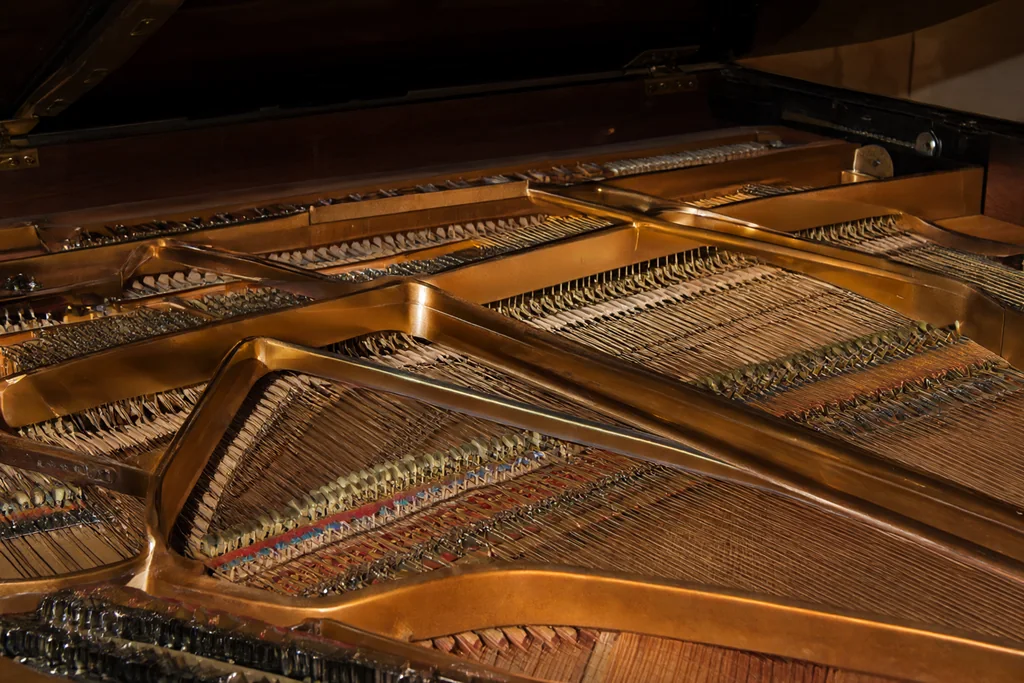
The piano looks like a keyboard instrument and behaves like a percussion instrument. Its sound is produced by hammers striking strings, and the keyboard is only a mechanism for controlling those hammers. Understanding that fact explains a great deal about the instrument's character, its enormous range and its ability to stand in for an entire orchestra.
Because a single player can produce many notes at once, the piano has one of the largest repertoires of any instrument. It is also a rehearsal instrument, a composition tool and the instrument most listeners have at hand.
How the sound is made
Pressing a key lifts a hammer that strikes one or more strings, which vibrate until they are damped. A heavier press produces a louder sound, not a different pitch, and the mechanism gives the player direct control over attack. Sustain is the difficulty: once a note is struck, it can only fade.
The instrument's expressive problem is therefore continuity. A pianist cannot shape a single note the way a singer can, so phrasing has to be built across groups of notes.
The three pedals
The right pedal lifts all the dampers at once, letting strings ring on and allowing sympathetic vibration between them. The left pedal softens the sound by shifting the mechanism. The middle pedal varies between instruments and composers, quietening or sustaining only a selection of notes.
Pedalling is a significant part of interpretation. The same passage played with different pedal use can sound clean, hazy or blurred, and the choice belongs to the performer.
What to listen for
- Attack: whether a note is struck sharply or eased in.
- Pedic: whether the harmony stays clear or blends together.
- Balance: how melody and accompaniment are shared between the two hands.
- Range: how far apart the outer parts travel.
- Resonance: how long the sound lingers after the key is released.
The two hands often do quite different work, and the balance between them is where a performance succeeds or fails.
The piano and its relatives
| Instrument | Sound production | Characteristic use |
|---|---|---|
| Grand piano | Hammers strike horizontal strings | Concert performance, wide dynamic range |
| Upright piano | Hammers strike vertical strings | Domestic and rehearsal use |
| Harpsichord | Strings plucked by a mechanism | Baroque repertoire, even dynamics |
| Organ | Air through pipes | Sustained sound, sacred music |
| Electronic keyboard | Sampled or synthesized | Practice and contemporary work |
Why it can imitate an orchestra
Because both hands can play different textures simultaneously, the piano can present melody and accompaniment together, or several independent lines at once. Composers have written piano works that transcribe orchestral scores, and the transcriptions are convincing precisely because the instrument can suggest many voices at once.
That capacity is also why the piano is the standard instrument for studying composition. A score reduced at the keyboard reveals the harmony and the counterpoint immediately.
Learning to hear the mechanism
Because the piano strikes its strings rather than bowing or blowing them, every note begins with a small impact. Listen for that attack: it is present even in the softest playing, and it is the reason a piano line sounds articulated rather than flowing. Singers and string players can begin a note without an edge; a pianist cannot.
Once you notice the attack, the shaping of a phrase becomes audible as a sequence of small impacts arranged into a curve. That is what pianists mean when they speak of voicing, and it is the central skill of the instrument.
Where to go next
Listen to a short piano piece twice, concentrating on the pedal and then on the balance between the hands. Neither detail is usually noticed on a first hearing, and each one changes the impression of the whole performance.
Read next
The sections of the orchestra and how they work together
Strings, woodwind, brass and percussion: roles, ranges and how they blend.
The string family: violin, viola, cello and double bass
Four sizes of one idea, and why the string body carries so much of the repertoire.
Woodwind and brass: how the wind sections differ
Reeds and lips, colours and blending, and why the two families are kept apart on the page.