
Home › Instruments & Orchestra
The sections of the orchestra and how they work together
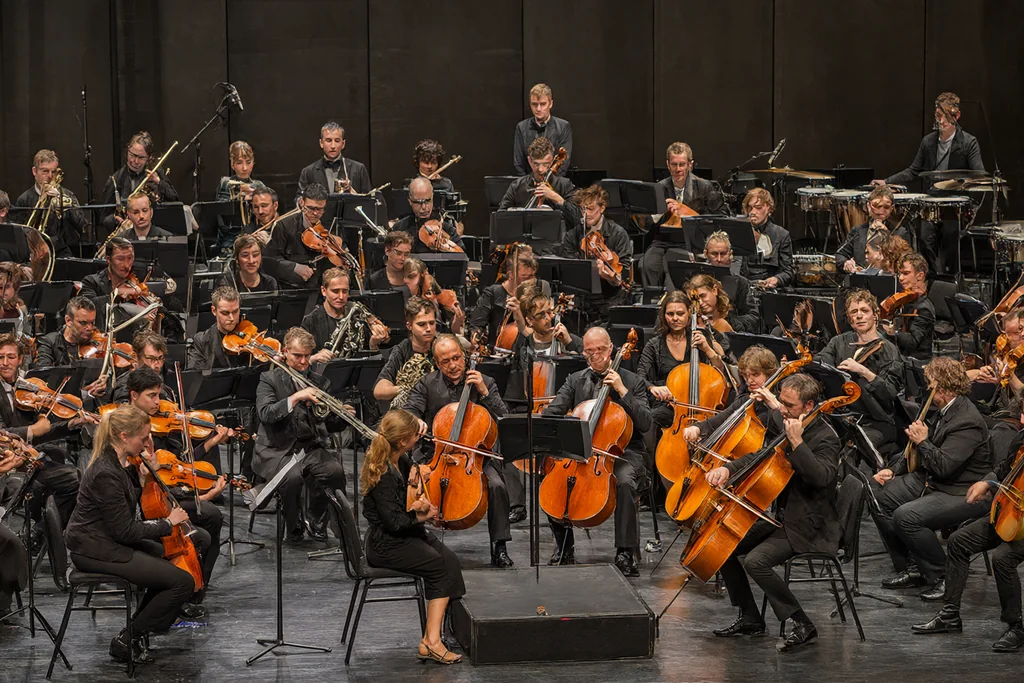
An orchestra is organised into four sections, and knowing them is the fastest way to make sense of a large ensemble. The sections are grouped by how their instruments produce sound: bowed strings, woodwind blown through a reed or an edge, brass sounded by the lips, and percussion struck or shaken. Each group has a characteristic blend, and most orchestral writing depends on how those blends are combined.
The grouping is not arbitrary. Instruments within a family share a method of sound production, so they blend easily with each other and contrast sharply with the other families. A composer can therefore use a section as a single mass of colour or split it into individual voices.
The string section
Strings are the largest group and usually carry the main melodic material. The section is divided into first violins, second violins, violas, cellos and double basses, with the higher instruments generally taking the melody and the lower ones providing the foundation. Because a section is many players on the same part, its sound is rich and sustained.
Strings can also be divided into smaller groups for contrapuntal writing, which is why so much chamber music and so many fugal passages in orchestral works are given to them.
The woodwind section
Woodwind instruments are individually coloured, so each one tends to be treated as a solo voice rather than blended into a mass. Flutes, oboes, clarinets and bassoons form the core, with related instruments added for special effects. Their lines often answer the strings rather than doubling them.
Each instrument has a distinct personality: one bright and penetrating, another hollow and reedy, a third warm and rounded, a fourth dark and humorous. Composers exploit those differences constantly.
The brass section
Brass instruments are powerful and directional, and they are used for weight, ceremony and climax. Horns, trumpets, trombones and tuba make up the standard group, with horns valued especially for their ability to blend with both strings and woodwind.
Because brass can overwhelm a small ensemble, it is often held back until the music needs it. The arrival of the full brass section is one of the most reliable signals in orchestral music.
The percussion section
- Instruments tuned to definite pitches, capable of melody as well as rhythm.
- Instruments of indefinite pitch, used for accent, colour and atmosphere.
- Instruments that add brightness, such as cymbals and triangles.
- Instruments that add depth, such as drums and gongs.
Percussion is used sparingly in most of the repertoire outside the twentieth century, which is precisely why each entrance tells.
The four sections compared
| Section | Method of sound | Typical role |
|---|---|---|
| Strings | Bowed (also plucked) | Melody, sustained harmony, foundation |
| Woodwind | Air across an edge or through a reed | Individual solo colours, answering lines |
| Brass | Vibrating lips | Weight, climax, ceremonial power |
| Percussion | Struck or shaken | Accent, rhythm, atmosphere |
| The whole | Balanced by size | Blend and contrast between groups |
How the balance works
A single trumpet can be heard over a full string section, so orchestration is a matter of matching forces. Composers write fewer brass notes and more string notes, and they thin the texture when a quiet solo needs to carry. When the balance sounds wrong in performance, the fault is usually one of coordination rather than of composition.
The number of players in each section varies with the repertoire. A Baroque work may use a dozen players in total, while a late Romantic symphony can call for a hundred. The proportions, though, remain recognisably the same.
Where to go next
Listen to one orchestral work and try to name the section that has the melody at four different moments. The answer will change several times, and the pattern of changes is a compact description of the orchestration.
Read next
The string family: violin, viola, cello and double bass
Four sizes of one idea, and why the string body carries so much of the repertoire.
The piano: a percussion instrument in disguise
How strings, hammers and pedals make the piano both intimate and orchestral.
Woodwind and brass: how the wind sections differ
Reeds and lips, colours and blending, and why the two families are kept apart on the page.