
Rhythm and metre: pulse, beat and bar
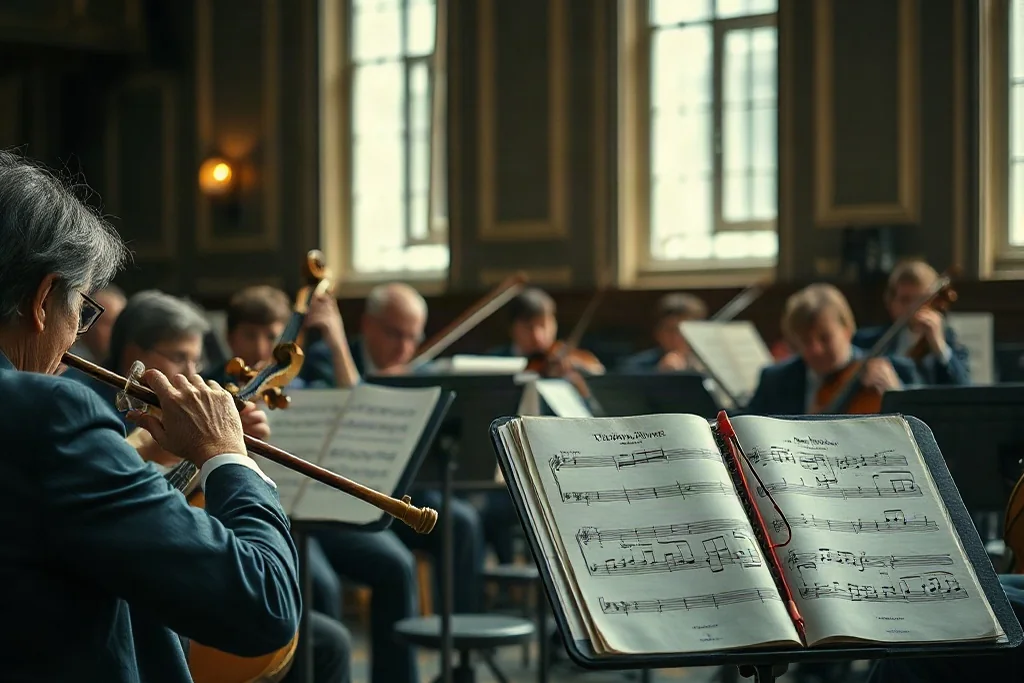
Rhythm is the pattern of durations in music, and metre is the framework that pattern is measured against. Both are felt rather than calculated by most listeners, but naming them helps explain why one passage feels like a march and another like a dance, and why a piece can feel simultaneously steady and unsettling.
The basic ingredients are simple: a pulse, a grouping of pulses into units, and patterns played against those units. Mastery of those ingredients is what makes a composer's rhythmic writing distinctive.
The pulse
Almost all music has a steady underlying pulse, which listeners instinctively tap. The pulse is not always audible as a sound; it is a grid the music moves on. When the pulse is explicit, as in a march or a dance, the music feels physical. When it is implied, the effect is more abstract.
Tempo determines how fast the pulse moves. The pulse itself remains even, unless the composer deliberately bends it.
Grouping into metre
Pulses are grouped into repeating units, and the pattern of strong and weak positions within each unit is the metre. Two beats in a unit feels like a march; three feels like a waltz. The sense of a regular cycle is what allows listeners to anticipate, and anticipation is a large part of musical pleasure.
Metre is written down as a time signature, but a listener hears it as a repeated shape of emphasis rather than as a number.
Playing against the metre
- Accenting a normally weak beat to create surprise.
- Shifting an accent just after the beat, creating a sense of push.
- Grouping notes so that they contradict the underlying cycle.
- Interrupting the cycle entirely with a pause or a held note.
These effects are grouped loosely under the idea of syncopation. They work because the listener is already holding the expected pattern in mind; the pattern must be clear before it can be contradicted.
Rhythm and metre compared
| Element | What it is | How you notice it |
|---|---|---|
| Pulse | Steady underlying beat | You tap along |
| Tempo | Speed of the pulse | The music feels quick or slow |
| Metre | Repeating group of beats | The music feels like a march or a waltz |
| Rhythm | Actual pattern of durations | Whether the surface is smooth or jerky |
| Syncopation | Accents against the metre | A sense of push or surprise |
Why metre is not mechanical
A metronome keeps a rigid pulse, and music does not. Performers shape the metre subtly, holding certain beats and pressing others, and the shaping is what produces expression. The underlying grid stays in place; the distance from it varies.
Listeners hear that variation even when they cannot measure it. A performance that ignores it sounds correct and lifeless, and the difference is entirely rhythmic.
A practical exercise
Tap the pulse of a piece, then try to feel the grouping. Once the grouping is stable, notice the moment the music accents a beat you had treated as weak. That moment is the whole point of metre as a musical device.
Rhythm in the concert hall
Rhythmic character is one of the few things an audience perceives immediately and physically. A listener who has never studied music can tell a march from a waltz and can feel the difference between a passage that drives forward and one that floats. That physical response is the metre doing its work.
It also explains why tempo disagreements matter so much in performance. A small change in the speed of the pulse alters the feel of the grouping, and with it the character of the whole movement.
Where to go next
Compare a march with a waltz. The difference in grouping is instantly audible, and once you have felt it the same distinction will be obvious in far less obvious music.
Read next
Keys and scales: the map behind the notes
Major and minor, tonality and why a key is a home rather than a limit.
Harmony basics: chords, cadences and tension
How chords support a melody and how a cadence tells you a phrase has closed.
Sonata form: exposition, development, recapitulation
The three-part shape behind countless first movements, described in plain terms.